Back to Blog
4 min read
Turn Language Learning into a Routine: Daily Practices While Learning a Foreign Language
M
Merve Yılmaz Canöz
Author
I am Dr. Merve Yılmaz Canöz. How did I get a B1 German Telc certificate in just 6 months, and with full scores in both the written and oral exams?
You, too, can easily learn Turkish.
Here are the daily tactics you can apply while learning a language, in this blog post.
Learning a new language is like a marathon; you don't have to study extremely hard, taking small steps every day is the key to permanent learning. Continuing to practice after leaving the language class or finishing a lesson turns what you've learned from passive knowledge into an active skill.
Whether you are learning Turkish or another language, we have brought together effective and enjoyable daily practices that you can easily integrate into your day.
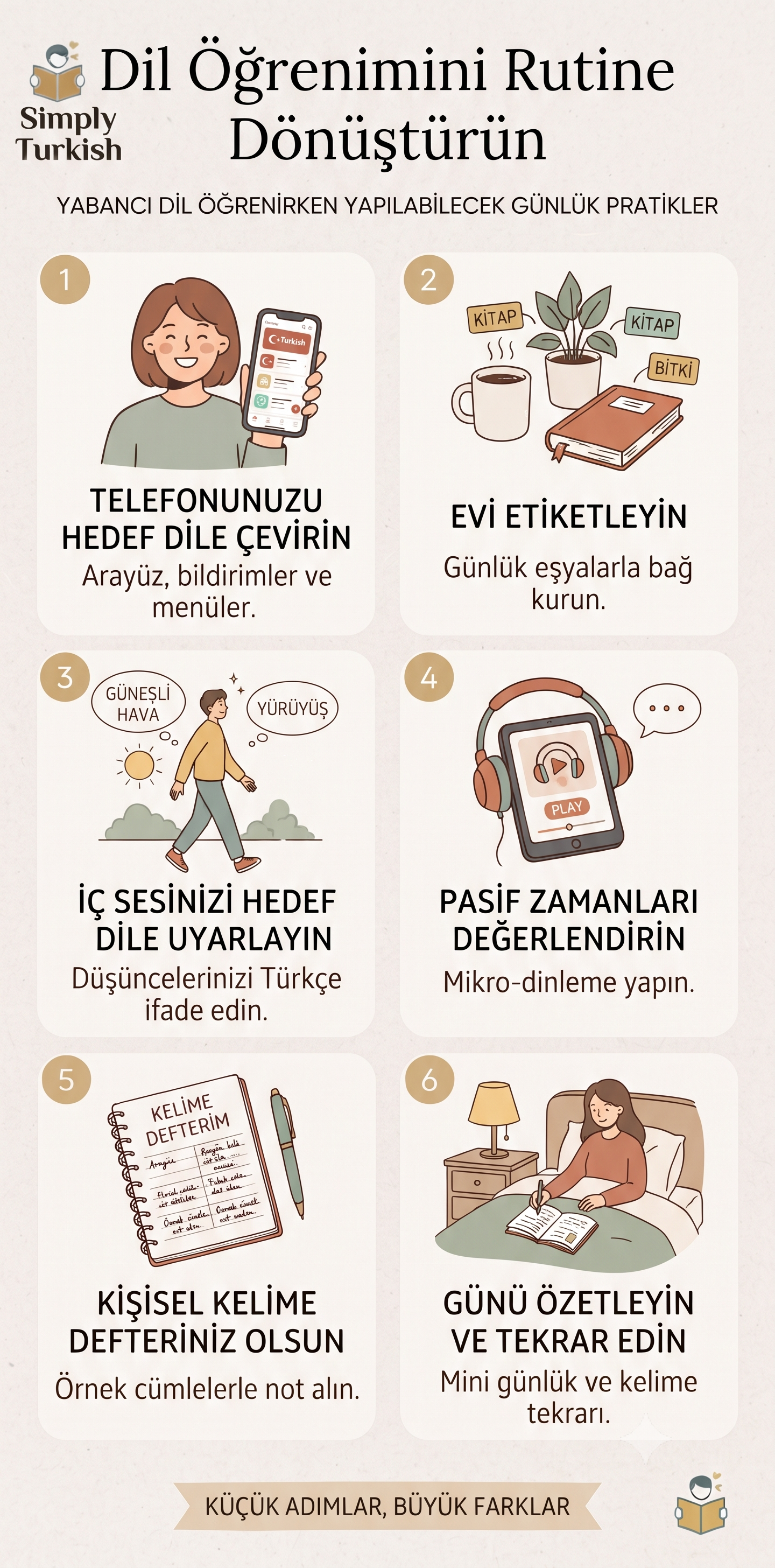
- Start Your Day with Language Practice (Switch Your Phone to Your Target Language)
One of the first things we do as soon as we wake up in the morning is check our phones. Turn this habit into an advantage.
What can you do?: Set the language of your phone, tablet, and social media accounts to the language you want to learn (for example, Turkish).
Benefit: Thanks to the interface terms, notifications, and menus you are exposed to throughout the day, your vocabulary develops effortlessly.
2. Equip Your Home with Target Language Labels
2. Equip Your Home with Target Language Labels
Visual memory is one of the most powerful tools in learning vocabulary. Establish a connection with the items you use frequently during the day in the target language.
What can you do?: Stick small post-it notes with their names in the target language onto household items (mirror, door, refrigerator, table, etc.).
Benefit: Every time you see that object, your brain automatically remembers the word in the target language, and the translation stage in your mind gradually disappears.
3. Adapt Your "Inner Voice" to the Target Language
3. Adapt Your "Inner Voice" to the Target Language
There are thoughts constantly passing through our minds during the day. Trying to make these inner monologues in the target language is one of the most practical ways to increase fluency.
What can you do?: While walking, preparing coffee, or waiting for the bus, try to express what goes through your mind in the target language. For example, construct simple sentences like: "Now I'm going to the market. I need to buy milk and bread." Check the words you get stuck on in the dictionary later.
Benefit: It overcomes the fear of speaking and trains your mind to think quickly in the target language.
4. Turn Passive Times into Active Learning (Micro-Listening)
4. Turn Passive Times into Active Learning (Micro-Listening)
While traveling, doing housework, or cooking during the day, put on your headphones and listen to the language.
What can you do?: Listen to short podcasts, songs, or daily dialogues appropriate for your level. You don't have to try to understand every word; just aim for the melody, intonation, and getting your ears accustomed to it.
Benefit: Listening a lot is the best way to learn natural pronunciation and stress.
5. Have a Personal Vocabulary Notebook
5. Have a Personal Vocabulary Notebook
One of the classic and most effective ways to make new words permanent is to keep a vocabulary notebook of your own.
What can you do?: Note down new words you hear, read, or encounter in classes during the day along with their meanings. Try to write words not just with their Turkish equivalents, but also along with how they are used in an example sentence.
Benefit: It ensures you don't forget the context of the words and gives you the satisfaction of building your own vocabulary.
6. Summarize the Day and Review Your Words (Mini Journaling)
6. Summarize the Day and Review Your Words (Mini Journaling)
Writing skills are a wonderful way to reinforce the grammar rules and words you have learned.
What can you do?: Right before going to sleep, write a very short paragraph of 3-4 sentences describing how your day went. If your level is beginner, simple sentences like "Today I drank a very nice coffee and read a little book" are enough. After you finish writing, quickly review the new words in the vocabulary notebook you created during the day, and then drift off into a peaceful sleep.
Benefit: Reviews done right before sleep increase retention in memory; what you write ensures you use grammar rules in the right places.
7. Consume Real-Life Content in the Target Language
7. Consume Real-Life Content in the Target Language
A language is not just about textbooks; it is also necessary to understand the culture of those who speak that language.
What can you do?: Cook by reading a recipe you love in the target language, watch a short YouTube video, or follow content creators in the target language on social media regarding a topic that interests you.
Benefit: You learn everyday conversational patterns (idioms, slang, natural expressions) that you won't find in books.
Conclusion: Small Steps, Big Differences
You don't have to study extremely hard; doing regular practice for 15-20 minutes every day yields much more permanent results. Try these small practices without putting pressure on yourself, within the flow of your daily life, and see the change with your own eyes!
Dr. Mervé Yılmaz Canöz